


Outdoor Digital Signage:Complete Buying Guide for 2027
Data indicates that the global digital outdoor advertising market is projected to grow from US$2.1 billion in 2026 to US$14.1 billion in 2033, representing a compound annual growth rate of 31.5 per cent. This demonstrates that market demand for outdoor advertising and its commercial recognition are steadily increasing.
Compared to indoor digital signage, outdoor digital signage must cope with more complex operating conditions. So, how do you choose a digital outdoor signage solution that truly meets the needs of your project? This article will guide you in finding a solution that balances display quality, environmental adaptability and long-term value by examining product definitions, core advantages, key selection criteria and practical application scenarios.
What Is Outdoor Digital Signage?
Outdoor digital signage refers to digital display equipment specifically designed for outdoor environments. Outdoor digital displays feature high brightness, weatherproofing and temperature control. Such outdoor digital displays can be used to display advertisements on high streets, provide wayfinding signage at bus stops, display public notices in parks, show real-time services at tourist attractions, and provide guidance information at sports venues.

Benefits of Outdoor Digital Signage
Outdoor digital signage helps businesses increase brand visibility, improve the efficiency of information dissemination and reduce long-term advertising costs.
1. High Visibility in Outdoor Environments
Standard displays are prone to issues such as dim images, glare and illegible content when used outdoors. Digital outdoor signage utilises high-brightness panels, anti-glare screens, and a corrosion-resistant, sealed housing that is waterproof and dustproof.
This design not only minimises the impact of external environmental factors on the equipment’s operation, but also ensures that the screen's content remains clearly visible in direct sunlight, rain, snow or other outdoor conditions, thereby continuously capturing the attention of passers-by and potential customers.
2. Flexible Content Management and Cost Savings
Digital outdoor signage systems controlled through a CMS offer real-time flexibility. You can remotely publish and update content at any time, without the printing, shipping, and manual replacement delays associated with traditional signage.
This flexible approach to content management not only improves the efficiency of advertising updates but also reduces the costs associated with printing, transport and manual replacement required for traditional advertising. At the same time, reducing the use of paper posters is more environmentally friendly.
3. Attract More Customers and Drive Sales
Customer attention is the key to driving purchases. Compared to traditional signage, bright and dynamic exterior digital signage is far more eye-catching. For example, digital signage exterior can be used to capture people's attention, thereby sparking their interest even before they enter the shop. This helps to increase footfall and improve conversion rates.
Placing digital signage exterior near shop windows or along vehicle routes can subconsciously reinforce the advertising message. When positioned in areas such as customer rest areas, customers can glance at the advertisements whilst taking a break, thereby influencing their purchasing decisions.
Exterior digital signage has delivered significant results. A report by Samsung indicates that a pilot scheme involving outdoor digital menu boards at 10 locations resulted in a profit increase of over US$1.4 million, whilst reducing costs by over US$1 million.
Key Factors to Consider When Choosing Outdoor Digital Signage
When selecting outdoor digital signage, you shouldn't focus solely on screen size and display quality. You also need to consider the signage’s environmental adaptability, security, installation requirements and ongoing maintenance.
1. Screen Brightness
Screen brightness is one of the most important factors when selecting outdoor digital display signs. Outdoor digital signage displays typically utilise high-brightness LCD screens, with common brightness ranges as follows:
1,500-2,500 nits: Suitable for certain outdoor environments with partial shade or where sunlight is relatively weak.
2,500-3,500 nits: Suitable for most outdoor applications requiring good visibility.
3,500-5,000 nits or higher: Suitable for locations with intense direct sunlight and high requirements for visibility from a distance.
In addition to brightness, you should also consider whether the screen features an anti-glare coating and automatic brightness adjustment. Anti-glare technology reduces reflections from ambient light, whilst automatic brightness adjustment adapts the screen's brightness to changes in ambient light, ensuring visibility whilst avoiding unnecessary energy consumption.
2. Weather Resistance
Outdoors, one of the most important protective features for equipment is resistance to water and dust. The IP rating is a key standard for measuring a device's resistance to dust and water.
For most digital signage displays that are exposed to the outdoors for extended periods, IP65 is the most basic protection option. You can check out our article, "IP65 vs. IP66: Which IP Rating Is Right for You," which provides a more detailed explanation of IP ratings.

3. Cooling and Heating Systems
In outdoor environments, digital signage outdoors may be affected by extreme temperatures. To ensure stable operation, digital signage outdoors should be
equipped with cooling systems to prevent overheating. Additionally, in cold environments, heating systems are necessary to prevent the digital signage exterior from freezing at low temperatures. These systems help ensure that the internal temperature of outdoor signage remains within a safe operating range at all times and extend its service life.
4. Robust Construction and Materials
The external protective structure also affects the user experience and long-term stability of outdoor digital displays. Outdoor digital displays should be able to withstand harsh environmental conditions, including extreme temperatures, humidity, and physical impacts. It is recommended to choose signage with a sturdy, impact-resistant metal frame, tempered glass, and a corrosion-resistant housing to ensure its service life.
5. Screen Size and Resolution
Screen size and resolution determine the display area and image clarity of advertising content. When making a selection, consider the following four factors:
Viewing Distance: When viewers are farther away from the display, consider a larger screen to improve content visibility.
Screen Dimensions: In addition to the diagonal size, verify the overall width and height of the outdoor digital display to ensure it fits the installation space.
Display Technology: For content viewed up close that emphasises text and image detail, LCD is a suitable choice; for advertisements displayed over a wide area or at a distance, LED is recommended.
Resolution: 2K is suitable for most standard advertising displays. 4K is recommended for applications requiring higher levels of image detail and clarity.
6. Installation and Maintenance
The installation method for exterior digital signage directly affects the device’s performance, installation difficulty, and future maintenance. Depending on the application environment, you can choose between wall-mounted, freestanding, or suspended mounting options. Before installation, you must confirm the following:
Whether the installation location has sufficient load-bearing capacity.
Whether there is a stable power supply and the necessary wiring conditions.
Whether the outdoor kiosk screen is at an appropriate viewing height and angle.
Whether the device requires additional wind-resistant mounting structures.
Whether it will be convenient to open the unit for maintenance later on.
Maintenance is equally important. After prolonged operation, outdoor equipment may experience issues such as dust accumulation, blocked heat dissipation channels, and ageing seals. Therefore, choose equipment with a well-designed maintenance structure. Make sure key components, such as the screen, fans, power supply, and control system, are easily accessible for inspection and replacement.
You can use the article “How to Reduce Digital Signage Failure Rate?” as a maintenance reference guide.
It is recommended to confirm the installation method, maintenance space, and after-sales support during the procurement phase to avoid incurring additional installation and maintenance costs later on.

7. Power Stability and Electrical Protection
Outdoor digital kiosk typically needs to operate continuously around the clock, so the stability of the power supply is of the utmost importance.
Therefore, choose an outdoor digital kiosk designed for continuous operation and equipped with a stable power supply. It should also include surge, leakage, and overvoltage protection to prevent malfunctions during storms or power fluctuations.
8. Touchscreen Options
Not all digital outdoor signage needs touch functionality. If your main goal is to display advertisements, promotions, or public announcements, a non-touchscreen display is usually sufficient.
However, if you want viewers to interact with the screen, such as searching for directions, finding stores, checking traffic information, or accessing product information, a touchscreen display is a better choice.
Outdoor Digital Signage Applications and VETO Display Solutions
Different outdoor settings impose varying requirements on the installation method, screen size, display orientation and housing design of digital signage. Below are several common outdoor digital display application scenarios and their corresponding equipment solutions.
1. Commercial Streets and Shopping Centres
High streets and shopping centres are among the most common settings for outdoor digital signage for business. In these areas, retailers need to attract the attention of passers-by through dynamic advertising. For such settings, you can choose different devices depending on the installation location:
Battery Powered Digital Signage
Portable outdoor digital signage is characterised by its flexibility and ease of deployment. You can adjust the location of the equipment according to different time periods and marketing campaigns. If your project requires frequent changes to the placement of advertisements, portable digital signage is a particularly suitable choice.

Freestanding Outdoor Digital Signage
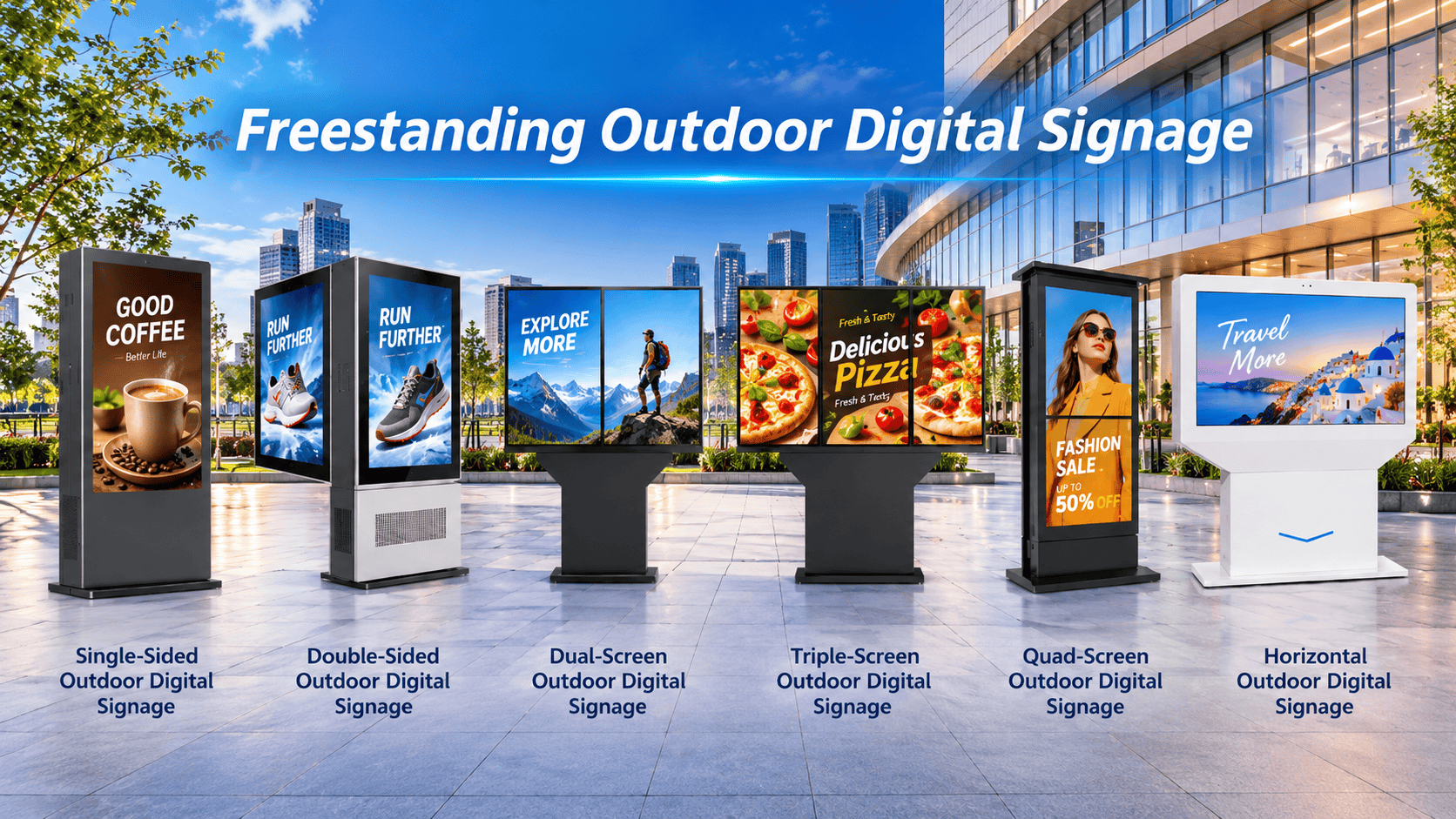
Outdoor digital kiosks are suitable for commercial plazas, the perimeters of shopping centres, pedestrianised streets and open public spaces. They typically feature a freestanding design, allowing them to function as standalone advertising terminals.
Depending on specific display requirements, the following configurations are available:
Single-Sided Outdoor Digital Signage: Suitable for displaying advertisements facing a fixed direction of foot traffic.
Double-Sided Outdoor Digital Signage: Suitable for displaying advertisements to audiences in two different directions.
Dual-Screen Outdoor Digital Signage: Suitable for situations requiring the simultaneous display of two sets of content.
Triple-Screen Outdoor Digital Signage: Provides a larger advertising display area.
Quad-Screen Outdoor Digital Signage: Suitable for displays requiring multiple screens.
Horizontal Outdoor Digital Signage: Suitable for displaying landscape-oriented advertisements or wide-format visual content.
The suitability of these product configurations is not simply determined by the number of screens. You should determine the appropriate configuration based on the available space, viewing direction, advertising content and budget.
2. Building Exteriors and Storefronts
If you need to display information whilst making the most of limited wall space, wall mounted outdoor digital signage can minimise the space taken up on the ground whilst enhancing the impact of advertising on the exterior of a building.
Depending on your installation requirements, you may wish to consider the following products:
Ultra-Slim Wall-Mount Outdoor Digital Signage: Featuring a relatively slim profile, it is suitable for projects with strict thickness requirements.
Landscape Wall Mounted Digital Signage: Suitable for displaying content in landscape orientation.
Portrait Wall Mounted Digital Signage: Suitable for displaying content in portrait orientation.
Side-Mounted Digital Signage: This typically utilises a side-mounted structure, with the screen facing either side of the building or different pedestrian viewing directions.
3. Transportation Hubs
Public transport venues such as railway stations, high-speed rail stations and bus stops need to strike a balance between the effectiveness of information display and the practical requirements of the installation environment.
Hanging Outdoor Digital Signage
Hanging outdoor digital signage is suitable for semi-outdoor waiting areas such as railway stations and high-speed rail stations. It can be installed at a higher position, minimising the space occupied at ground level whilst ensuring that information is more easily visible to passengers.
Smart Bus Stop Digital Signage
Landscape outdoor digital signage with canopy is suitable for bus stops and open-air waiting areas. The pole-supported structure, combined with the overhead canopy, provides some shelter for the equipment whilst displaying advertisements and public information. The landscape-oriented screen is ideal for displaying bus routes, real-time traffic information and wide-format advertisements.
4. Public Spaces and Outdoor Information Points
Depending on your specific requirements, you can choose:
Outdoor Non-Touch Digital Signage: Suitable for park entrances, squares and main thoroughfares in tourist attractions, for displaying public information and advertisements.
Outdoor Touchscreen Kiosk: Suitable for information points in tourist attractions and parks, for map enquiries and interactive services.
Final Thoughts
Different installation environments and advertising display requirements mean that the configuration needs for outdoor digital signage also vary. Choosing the right exterior digital signage not only maximises its value but also reduces the likelihood of faults and minimises long-term maintenance costs.
With 19 years of experience in LCD display manufacturing, VETO is a commercial display manufacturer specialising in R&D, design, production, and sales. Our products have been exported to over 80 regions worldwide.
We provide reliable and durable outdoor digital signage solutions. Contact us to learn more!
FAQ
What is the difference between indoor and outdoor digital signage?
The main difference between indoor and outdoor digital signage lies in their ability to adapt to their environment. Indoor equipment doesn’t require a high level of protection, whereas outdoor digital signage must withstand direct sunlight, rain, dust and temperature fluctuations. It is therefore typically fitted with high-brightness screens, waterproof and dustproof casings, and specialised temperature control systems.
How can you ensure outdoor signage is visible in direct sunlight?
Outdoor signage typically requires a brightness of at least 1,500–2,500 nits. For open areas exposed to strong direct sunlight, it is advisable to consider displays with a brightness of 2,500–5,000 nits or higher.
Can digital outdoor signage run 24/7?
Yes, but first make sure the equipment you purchase is rated for 24/7 commercial operation.
Can digital signage outdoor work in rain and snow?
Yes, commercial outdoor displays are designed to be extremely durable and weather-resistant. They have a specific protection rating that safeguards their internal components from dust, rain and extreme temperatures.
How long does an outdoor digital display last?
With proper maintenance and care, the lifespan of an outdoor LCD display can range from 5 to 10 years.


Send your inquiry
Name*
Email*
Whatapp
Your Requirements*
Never miss a moment
E-mail*
*


