


How to Choose the Right Outdoor Digital Kiosk for Your Business
Digital signage kiosks used in outdoor settings face far more complex challenges than those used indoors. From shopping streets to bus stops, an outdoor digital kiosk must withstand exposure to UV rays, rain and even accidental impacts. Purchasing the wrong digital display can prove to be a costly mistake—either by sacrificing reliability in the pursuit of the lowest price, or by wasting resources through the blind selection of high-end specifications.
So, what factors should you consider when purchasing an outdoor digital kiosk? Drawing on practical procurement requirements, this article will help you understand the key specifications, compare different configurations, and select a reliable and durable outdoor digital kiosk.
Important Factors When Choosing an Outdoor Digital Kiosk
1. Screen Brightness
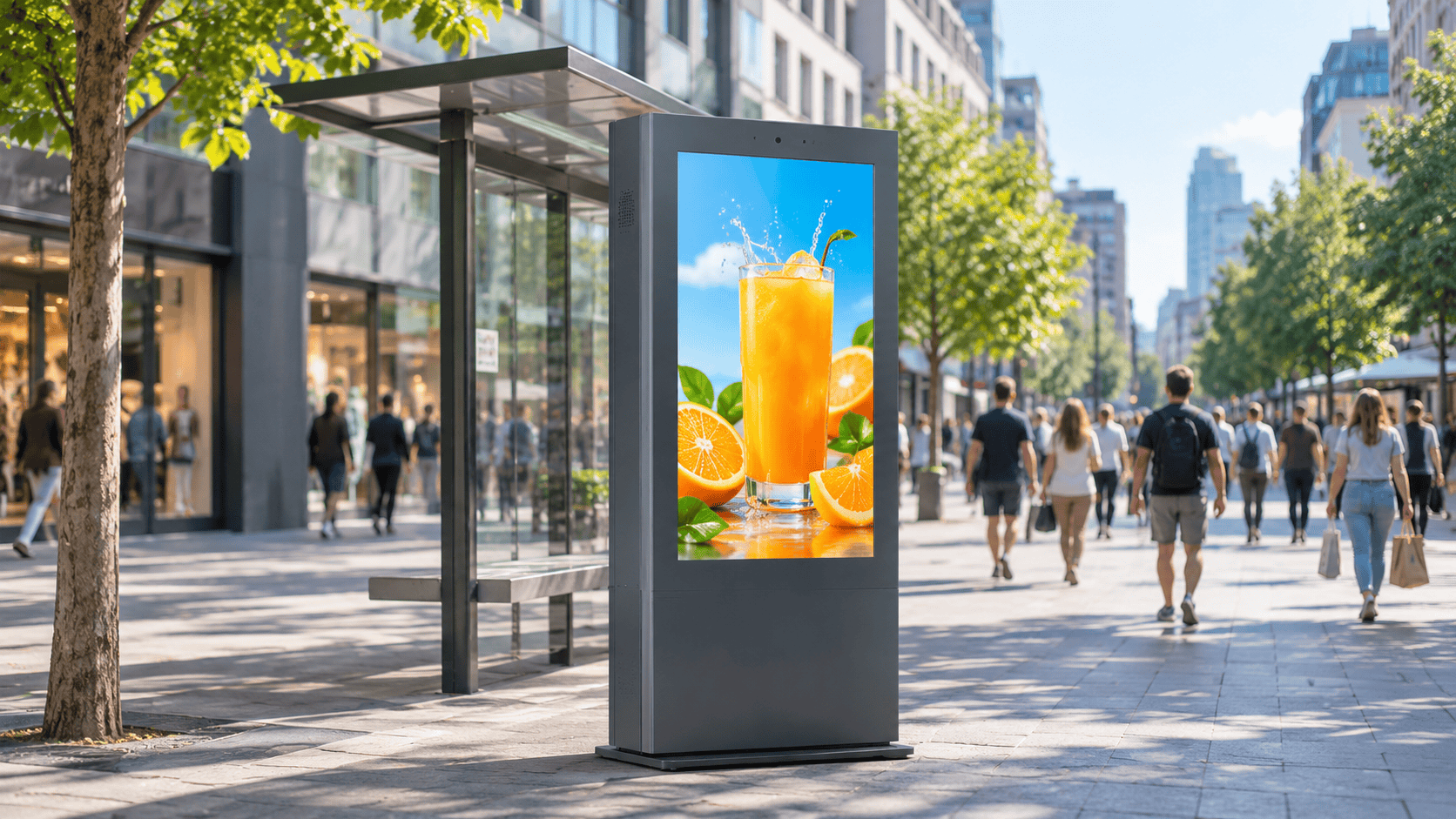
Outdoors, screen brightness is a crucial consideration. The higher the brightness value in nits, the brighter the screen. If the brightness of an outdoor digital screen is too low, the content displayed will be impossible to see in direct sunlight or bright ambient light. In direct sunlight, the brightness of an outdoor kiosk screen must be at least 1,500 cd/m² to ensure the content remains clearly visible. Therefore, the choice of the right brightness is crucial. You wouldn’t want to buy an outdoor digital kiosk only to find that customers can’t see anything on the screen when the sun comes out – that would be no different from a mere ornament.
2. IP Rating
As outdoor equipment is constantly exposed to rain and dust, water and dust resistance are factors that must not be overlooked when selecting an outdoor display kiosk.
What Is an IP Rating?
IP stands for Ingress Protection. It is a protection rating system established in accordance with the IEC 60519 standard, used to indicate the degree of protection provided by the enclosure of electrical equipment against solid foreign objects and water.
An IP rating typically consists of 'IP' followed by two digits, for example, IP65 or IP66. The first digit indicates the equipment's level of protection against solid foreign objects, such as dust. The second digit indicates the equipment's level of protection against water. The higher the number, the greater the level of protection against the corresponding hazard.
IP65 vs. IP66
When it comes to outdoor digital signage, IP65 and IP66 are two ratings that deserve particular attention during the procurement process.
Protection Rating | Dust Protection | Water Protection |
IP65 | Complete protection against dust | Protection against low-pressure water jets from any direction |
IP66 | Complete protection against dust | Protection against powerful water jets from any direction |
The main difference between the two lies in the second digit, which indicates the level of water resistance. IP66 offers a higher level of water resistance than IP65.
How to Choose Between IP65 and IP66?
For outdoor digital kiosks intended for long-term installation outdoors, IP65 is the most basic protection requirement. You can make your selection based on the actual installation environment:
Choose IP65: If the device is installed in a standard outdoor environment where protection against normal rain and dust is required, IP65 is usually a sensible choice.
Choose IP66: If the device is installed in an environment prone to heavy rainfall, susceptible to powerful water jets, or requiring a higher level of water protection, IP66 may be suitable.
Generally speaking, IP66 devices may require more sophisticated manufacturing processes, higher-grade materials and more extensive testing, and are therefore likely to be more expensive than IP65 products with equivalent specifications. You should not simply aim for the highest IP rating. Instead, you should select the appropriate protection rating based on the operating environment. For example, in arid regions, there is little need to use IP66.

3. Cooling and Heating Systems
In outdoor environments, outdoor digital kiosks may be subject to extreme temperatures. To ensure their stable operation, equipment fitted with cooling systems—such as fans or heat sinks—should be selected to prevent overheating. Furthermore, in cold environments, heating systems are required to prevent the display from freezing in low-temperature conditions.
These systems help to ensure that the internal temperature of the outdoor display kiosk remains within a safe operating range at all times, thereby extending its service life.
4. Robust Construction and Materials
The external protective structure also affects the user experience and long-term stability of the outdoor digital signage kiosk. It should be capable of withstanding harsh environmental conditions, including extreme temperatures, humidity and physical impact. It is recommended to select signage featuring a sturdy, impact-resistant metal frame, toughened glass and a corrosion-resistant casing to ensure its longevity.
5. Screen Size and Resolution
Screen size and resolution have a direct impact on how effectively advertising content is displayed. These should be selected taking into account the actual installation space and viewing distance.
When making your selection, you should consider the following factors:
Viewing Distance: If viewers are at a distance from the device, consider a larger screen to improve the visibility of the advertising content.
Screen Dimensions: In addition to the screen’s diagonal size, confirm the overall width and height of the outdoor kiosk display to ensure the unit fits the installation location, particularly in areas with limited space such as shopping centre entrances and passageways.
Content Layout: If the display will primarily show portrait-oriented posters or promotional content featuring people, a portrait-oriented design may be appropriate. If it will primarily show landscape-oriented videos and wide-format advertisements, a landscape-oriented design may be appropriate.
Resolution: 2K is sufficient for most standard advertising display requirements. If richer image detail is required, 4K may be considered.
6. Installation and Maintenance
When purchasing an outdoor digital advertising display, you should also consider installation and ongoing maintenance. You will need to confirm in advance the installation method, location and ground conditions. For example, with floorstanding digital signage, you need to consider base anchoring, ground levelness and the stability of the installation site. For digital signage installed outdoors, theft prevention should also be taken into account.
Following prolonged use, outdoor digital kiosks will require screen inspections, internal cleaning, and maintenance of the cooling and heating systems.
Before purchasing, you should confirm the following with the supplier:
Can they supply commonly used spare parts?
Do they provide remote technical support in the event of equipment failure?
What is the scope of the warranty and the duration of after-sales service?
Choosing a supplier with comprehensive after-sales support can help minimise communication costs during subsequent equipment maintenance.
7. Power stability
As outdoor digital kiosks typically need to operate continuously, round the clock, the stability of the power supply is of the utmost importance. It is therefore advisable to select outdoor digital kiosks that are designed for continuous operation, feature a stable power supply and are equipped with surge protection, earth leakage protection and overvoltage protection, in order to prevent malfunctions during storms or power grid fluctuations.

Choose a Reliable Outdoor Digital Kiosk Manufacturer
When selecting a suitable outdoor digital kiosk, it is important not only to focus on the product’s specifications but also to consider the manufacturer’s production capacity, quality control and after-sales support.
1. Manufacturing Experience
Find out whether the supplier has experience in the research, development and production of commercial display equipment. You can assess the scale of their factory, production facilities, product range and past project case studies to determine whether they possess stable production capacity.
2. Quality Control and Certifications
As outdoor digital kiosks need to operate for extended periods in challenging environments, product quality control is of paramount importance. When making a purchase, you should ascertain whether the manufacturer has comprehensive quality inspection procedures in place, such as assembly checks, ageing tests and final quality inspections before dispatch.
Additionally, confirm that the products hold the necessary certifications or compliance documents, such as CE, FCC and RoHS.
3. Customisation and After-Sales Support
If you have specific project requirements, you should confirm in advance whether the manufacturer supports: custom screen sizes, body colour and exterior design, brand logo customisation, hardware configuration adjustments and customised mounting structures.
Furthermore, you should ascertain whether the supplier can provide spare parts, technical support and warranty services.
Final Thoughts
Different installation environments and advertising display requirements mean that the configuration requirements for outdoor digital kiosks also vary. Choosing the right outdoor digital display not only ensures that advertising content is displayed clearly, but also reduces the likelihood of faults and minimises long-term maintenance costs.
With 19 years’ experience in LCD display manufacturing, VETO is a commercial display equipment manufacturer specialising in research and development, design, production and sales. Our products are exported to over 80 regions. We offer reliable and durable outdoor digital kiosks; please feel free to contact us.
Frequently Asked Questions
1. What is the minimum IP Rating for an outdoor digital kiosk?
We recommend selecting at least IP65. This rating provides complete protection against dust and withstands low-pressure water jets from any direction. If the equipment needs to withstand stronger water jets, IP66 should be considered.
2. Is IP66 better than IP65 for outdoor digital signage?
Yes. Both offer the same level of dust protection, but IP66 provides superior water resistance compared to IP65.
3. What brightness is suitable for an outdoor digital display?
In areas exposed to direct sunlight, the screen brightness should be at least 1,500 nits. The specific requirement will depend on the environment in which the outdoor display kiosk is located.
4. Can an outdoor display kiosk operate 24/7?
Most professional outdoor digital kiosks support 24/7 continuous operation, but not all products are capable of this. You will need to confirm this with the supplier.
5. What is the difference between indoor and outdoor digital signage?
The main difference lies in their environmental adaptability. Indoor digital signage is not typically exposed to direct rain or heavy dust, whereas outdoor digital signage requires higher levels of water and dust resistance, greater screen brightness, and heat dissipation and housing designs suitable for outdoor environments.
6. Can an outdoor digital kiosk be customised?
Yes, VETO offers OEM and ODM customisation, including screen size, colour, appearance, configuration and printed logos.
7. Can these outdoor digital kiosks be fitted with touchscreens?
Yes, we can supply both outdoor touch screen kiosks and outdoor non-touchscreen kiosks.


Send your inquiry
Name*
Email*
Whatapp
Your Requirements*
Never miss a moment
E-mail*
*


