


What Is Spatial Signage and How Does It Create a 3D Visual Effect?
When flat posters struggle to catch the eye and traditional naked-eye 3D screens face challenges such as high production costs and complex content creation, Spatial Signage offers an alternative solution for commercial displays.Featuring a wall-mounted design, it uses virtual 3D depth-of-field effects to give product displays a greater sense of space while highlighting key details, making it ideal for scenarios such as brand storefronts, mall corridors, and corporate exhibition halls.
This article will explore the product features, application scenarios, and purchasing requirements to explain the display effects these spatial screens can deliver, the commercial environments for which they are suitable, and how to choose between 21.5-inch, 32-inch, or 55-inch models based on actual needs.
Spatial Signage is not just an "ordinary 3D screen", but rather spatial visual signage
Spatial Signage is a wall-mounted, glasses-free commercial digital signage display that emphasizes clear image quality and spatial depth—unlike traditional glasses-free 3D devices that prioritize intense full-screen 3D effects at the expense of clarity. Its core technology does not involve rendering the entire image in traditional glasses-free 3D; instead, it employs a “2D foreground subject + 3D depth-of-field background” rendering scheme. The foreground subject remains sharp at its native 2D resolution, while the background uses 3D depth-of-field algorithms to create a sense of space, achieving 3D visual effects within a 2D budget.
From a technical classification perspective, it falls under a branch of autostereoscopic displays;its features are quite similar to those of the Samsung Spatial Signage and Sony Spatial Signage solutions already on the market; you can compare them to gain a better understanding.Traditional glasses-free 3D lets you “see depth,” while Spatial Signage lets you “see the subject clearly while experiencing spatial depth.”In other words, a 2D-printed pattern creates a 3D visual effect—your existing white-background assets are enough to produce a spatial display.

What functions does spatial screen offer?
1. The subject is sharp, and the background has depth. The product itself is rendered in 2D resolution, so it doesn’t sacrifice clarity for a 3D effect like traditional glasses-free 3D does; the background uses depth-of-field algorithms to create spatial layers. It features high contrast, high brightness, natural and delicate colors, and no motion blur. This is the most fundamental difference from early glasses-free 3D devices—and it’s the difference customers notice at first glance.
|
|


2. The viewing angle is wide enough to prevent dizziness even after prolonged viewing. The most common criticisms of traditional glasses-free 3D are that “the image gets blurry if you stand even slightly off-center” and “you feel dizzy after just two minutes.” The spatial signage has been optimized to address these two pain points; it simply needs to be placed along the natural flow of customer traffic, requiring no specific viewing positioning and preventing customer attrition due to viewing discomfort.
3. Content can be created using white-background images—no need to wait for a 3D team. This is the most practical benefit for operations: simply upload Product videos or images with a pure white background, and the device automatically generates depth of field in the background while keeping the subject in sharp focus.
There’s no need for 3Dmodeling, multi-angle photography, or custom animations—existing white-background assets are ready to use, allowing for quick updates to promotions and displays. All three sizes share the same content logic, so assets don’t need to be recreated for different sizes.
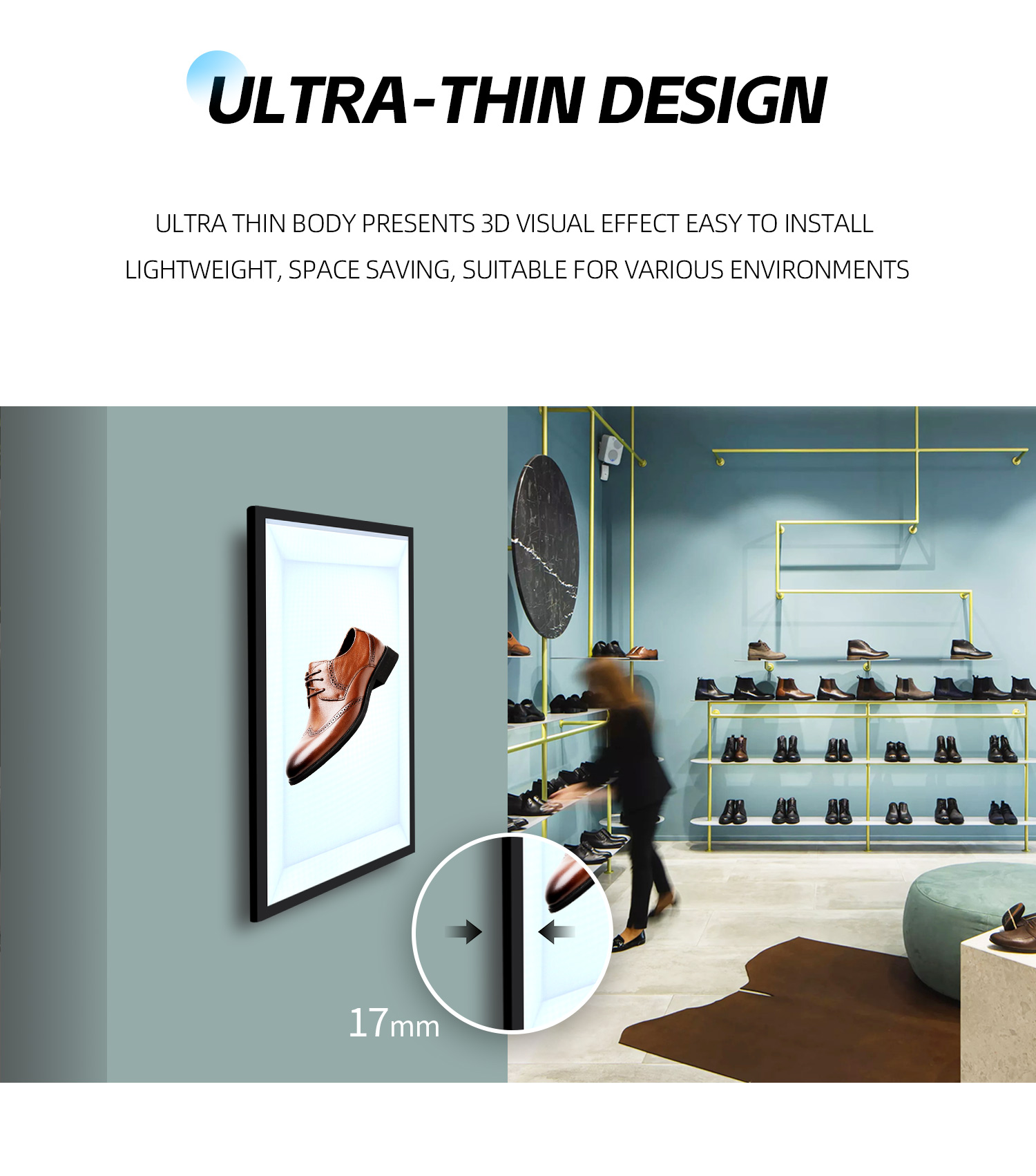
4. Ultra-thin wall-mounted design, install in either landscape or portrait orientation, with no daily maintenance required once installed. The unit is ultra-thin and lightweight; when mounted flush against the wall, it doesn’t obstruct foot traffic, and its appearance doesn’t resemble “industrial equipment.” It supports adaptive orientation for both landscape and portrait modes, so you don’t need to purchase two separate devices for vertical installation in storefront windows or horizontal installation on counters.
It supports scheduled power on/off and 24/7 continuous operation, eliminating the need for a dedicated person to turn it on and off daily after installation—making it ideal for unattended stores and advertising spaces in passageways. It supports virtually all mainstream image and video formats, and customers who need to integrate with existing playback control systems can install third-party control software.
5. Significantly more affordable than custom real 3D installations. Custom mechanical structures, holographic display cases, and custom-shaped 3D LCD installations require a high degree of hardware customization, involve complex installation, and come with significant maintenance costs.
This unit, however, utilizes a standardized commercial LCD screen combined with an optical depth-of-field solution: the hardware is standardized, it features wall-mounted installation, and content can be created using white-background materials, resulting in much lower overall production and deployment costs.
You can choose the size based on your specific situation
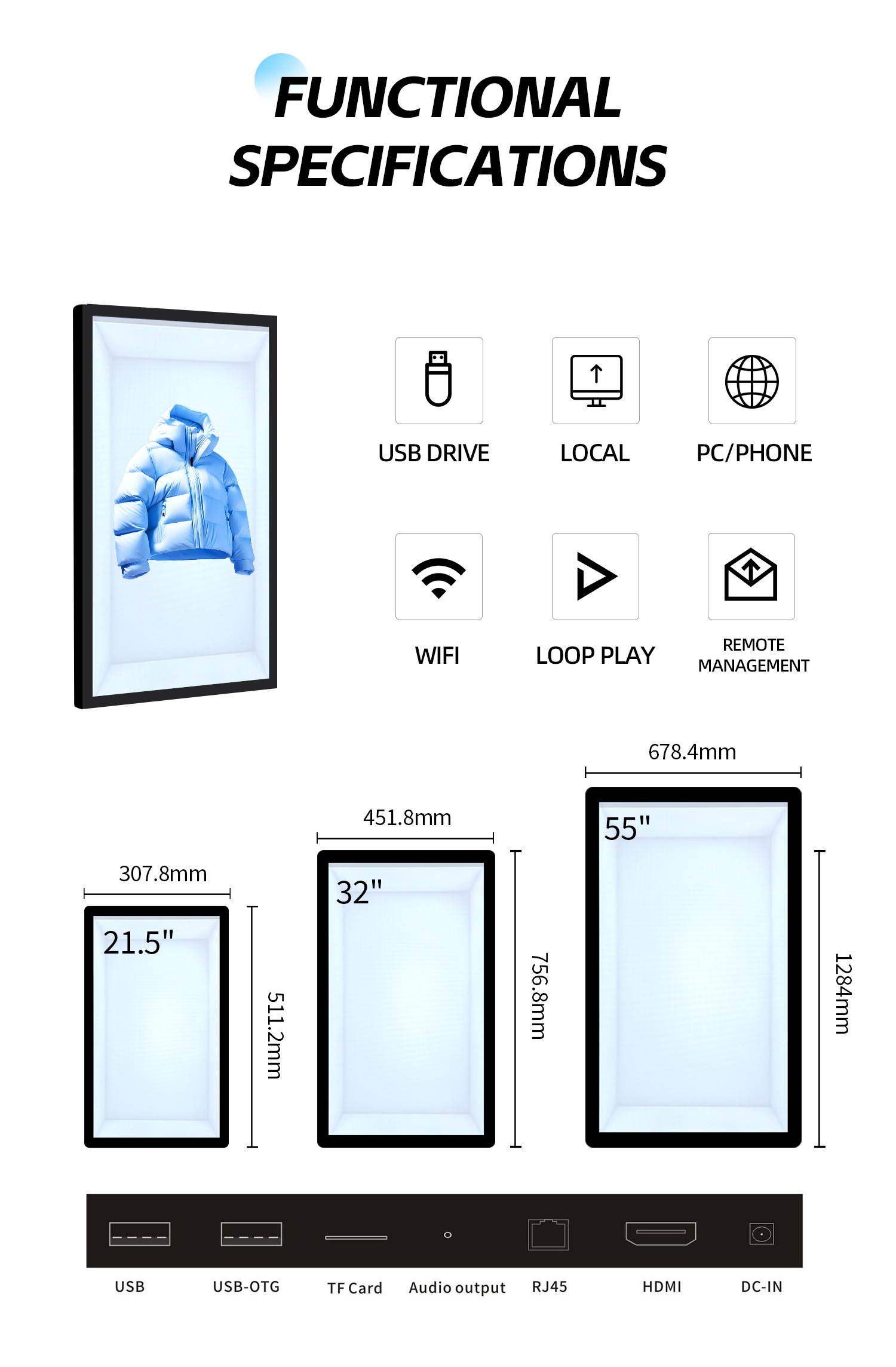
Brand stores and counter display windows—beauty, fashion, electronics, and apparel retailers use this to showcase products in 3D, replacing traditional poster light boxes. The 21.5-inch model is ideal for counters displaying small items and narrow display windows, while the 32-inch model works well for standard display windows and counter backdrops.
Customers can view products from the front, side, and back without having to wait for a sales associate to retrieve them. Existing product images with white backgrounds can be directly converted into 3D content, eliminating the need to recreate 3D models during seasonal changes; the low production cost makes it ideal for deployment across multiple locations. Adaptive landscape and portrait modes ensure compatibility with various store layouts.
|
|
|
|


Malls, shopping centers, and supermarket aisles; use 32-inch displays in corridors, elevator lobbies, and on side walls next to specialty counters; use 55-inch displays in atrium, main aisles, and large supermarket entrances. These 3D visuals interrupt pedestrians’ automatic navigation patterns, converting foot traffic into advertising reach. Standardized wall-mounting combined with a simple content delivery system ensures low deployment costs and rapid rollout per location; scheduled power on/off and long lifespan make these ideal for unmanned advertising spaces in commercial corridors managed by property operators. The 55-inch display offers broader coverage, making it suitable for locations where the 3D effect needs to be clearly visible from a moderate distance.

Corporate showrooms, reception lobbies, cultural exhibition halls, and museums; these displays can showcase product models, industrial components, and cultural artifacts, serving as information nodes integrated into the space alongside exhibition walls or reception desks. The 21.5-inch model is suitable for locations near display cases and close-range information points; the 32-inch model is suitable for standard exhibition walls; and the 55-inch model is suitable for main visual displays in lobbies or wall-mounted nodes in large exhibition halls.
The ultra-thin wall-mounted design preserves the overall aesthetic of the exhibition hall, and white-background images of exhibits can serve as the starting point for content; it supports third-party control software, facilitating integration with the venue’s existing playback and control systems. Compared to custom-built physical 3D installations, this solution offers better budget control and greater installation flexibility.
Who Should Buy This Product?
Ideal Buyers:
lBrand store operations and display procurement managers: Seeking to replace lightbox posters and increase foot traffic at store windows; looking to create content using existing pure whitebackground product video footage without relying on external 3D teams; aiming to control per-unit costs; and needing sizes that can be selected based on store type.
lShopping mall management and advertising operators: Seeking rapid deployment of aisle advertising spaces, centralized management across multiple locations, and unattended operation; the standardized wall-mounted design with scheduled power on/off perfectly meets these needs. Select sizes based on the aisle scenarios described in Section 3.
lDigital managers for corporate showrooms, exhibition halls, and museums: With limited budgets and installation constraints, they require lightweight, glasses-free 3D displays that can be launched using existing pure whitebackground product images and integrated with existing playback control systems. Select sizes based on the exhibition hall scenarios described in Section 3.
lOperators of small and medium-sized commercial spaces: Seeking to enhance spatial visual impact within a limited budget, rather than investing in large-area LED displays, flagship screens, or custom real-3D installations; 21.5-inch and 32-inch models offer a more lightweight entry point.
Scenarios requiring careful evaluation: Large outdoor advertising spaces primarily viewed from a distance; outdoor main screens requiring ultra-wide coverage; and highly interactive touchscreen guided tour scenarios. Although the 55-inch model covers a larger viewing area, it remains an indoor commercial display device and cannot replace high-brightness outdoor screens. If you’re looking for the visual impact of a large outdoor screen viewed from a distance or a large-scale custom 3D installation, this solution will not meet your needs.
Conclusion
The value of wall-mounted 3D Spatial Display lies in its lower cost, simpler deployment, a low-threshold content workflow that generates depth of field using pure whitebackground materials, and the flexibility to choose screen sizes ranging from 21.5 inches to 55 inches based on viewing distance.
Whether placed next to shelves, at counters, in store windows, or on display walls, it transforms what would otherwise be flat product displays into three-dimensional experiences that give shoppers a reason to linger. It is not intended to be more “stunning” than large screens, nor is it meant to replace all physical 3D installations.
FAQ
Q1 What kind of images do I need to prepare?
A:Product photos with a pure white background can be used as-is; 3D modeling is not required. Images without a white background must first have the background removed—this is the only step that requires advance preparation.
Q2 What will it actually look like on spatial screen?
A:On a spatial screen, the main subject is clear, and the background has depth. The product appears to be standing within the screen, with space extending behind it, rather than the entire image protruding outward.
Q3 Will viewers feel dizzy or need to stand in a specific spot?
A:No. The viewing angle is wide enough; simply place it where customers naturally walk by. There’s no need to direct where they stand, and it’s unlikely to cause dizziness.
Q4 Which size should I choose?
A:First, consider how far away the audience will be standing: 21.5 inches for close viewing, 32 inches for medium viewing, and 55 inches for slightly farther distances or when a larger display is needed.
Q5 How does the cost compare to a custom 3D installation?
A:It is much more affordable than custom mechanical structures, holographic display cases, or custom-shaped 3D LED installations. Standard wall-mounted units paired with white-background content are sufficient, and deployment costs are low.
Q6 What is it NOT suitable for?
A:Long-distance outdoor advertising, extra-large atrium main screens, and highly interactive touchscreen scenarios. The 55-inch model is still an indoor commercial device and cannot replace high-brightness outdoor screens.


Send your inquiry
Name*
Email*
Whatapp
Your Requirements*
Never miss a moment
E-mail*
*


