


Digital Signage For Restaurant& Choosing the Right Display for Customer Flow
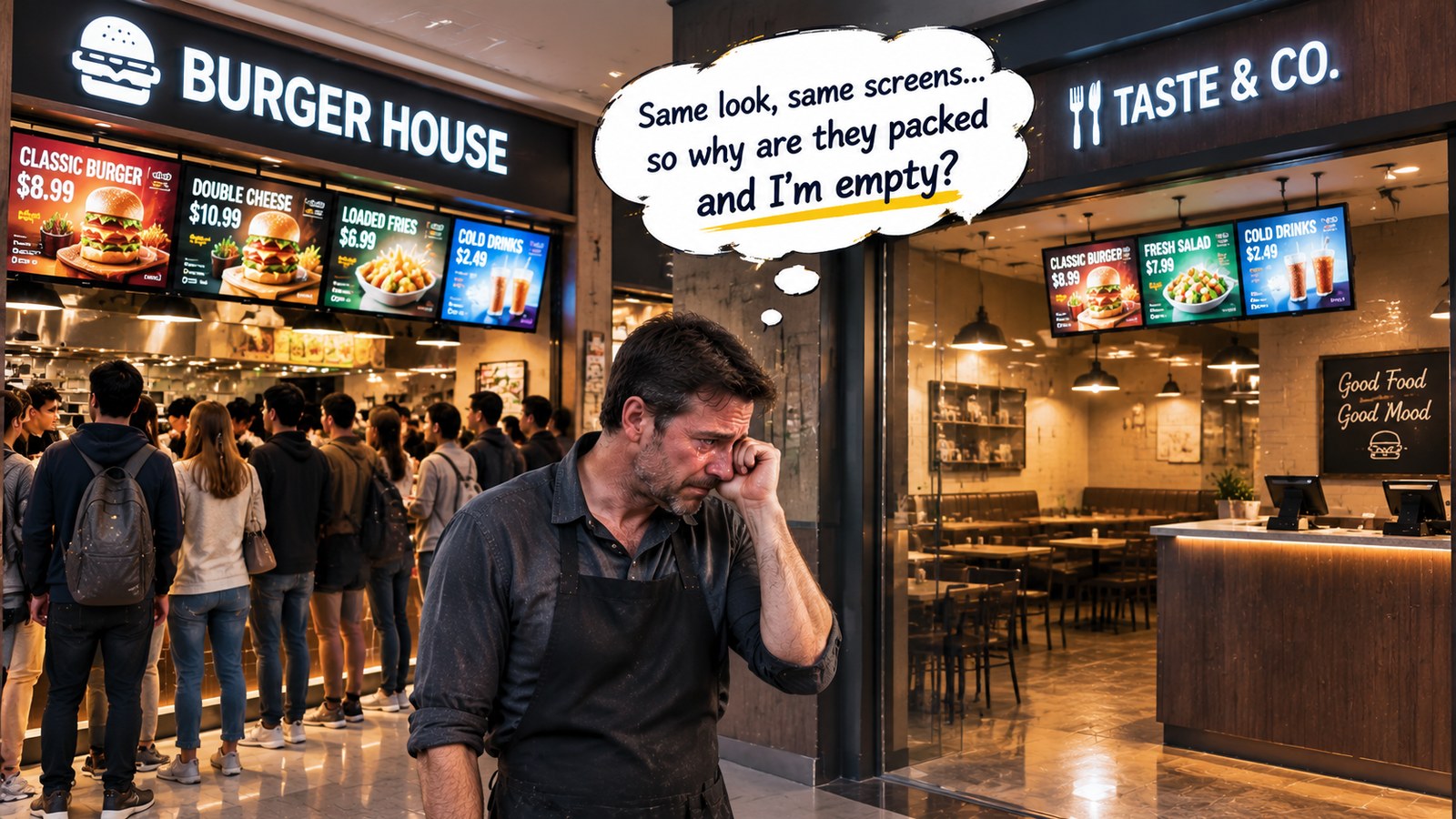
When choosing a digital signage display, many business owners start by measuring the space, asking for quotes, or checking how nearbystores have installed their screens. However, after installing the screen, it turned out that it barely attracted any customers. The issue
likely had nothing to do with the screen itself, but rather with where it was positioned.
It’s like putting on a show in the middle of nowhere. No matter how good the performance is, nobody sees it or even knows it happened.
Restaurantdigital signage works the same way. Even with great content and a sharp display, the screen can go unnoticed if it isn’t placed where customers will look when they need information.
Your Service Format Decides the Digital Displays
At a fast-food counter, customers look at the menu and order in tens of seconds. Coffee shops and bakeries give them more time. More
time means you can show more on the screen. Viewing distance works the same way. A simple rule: 1 inch of letter height for every 10
feet away. Before you pick a screen, know your service format and your customer. Then stand where they stand. Ask yourself: which
screen and content would catch their eye?
Before choosing a screen, think about how customers move through your store. Where do they walk? Where do they stop? At what point do they hesitate? Identify where customers are likely to focus their attention, then decide where to install the screen so they can see the
information they need when they’re ready to make a decision.
Digital Tabletop Display AddingMore Orders
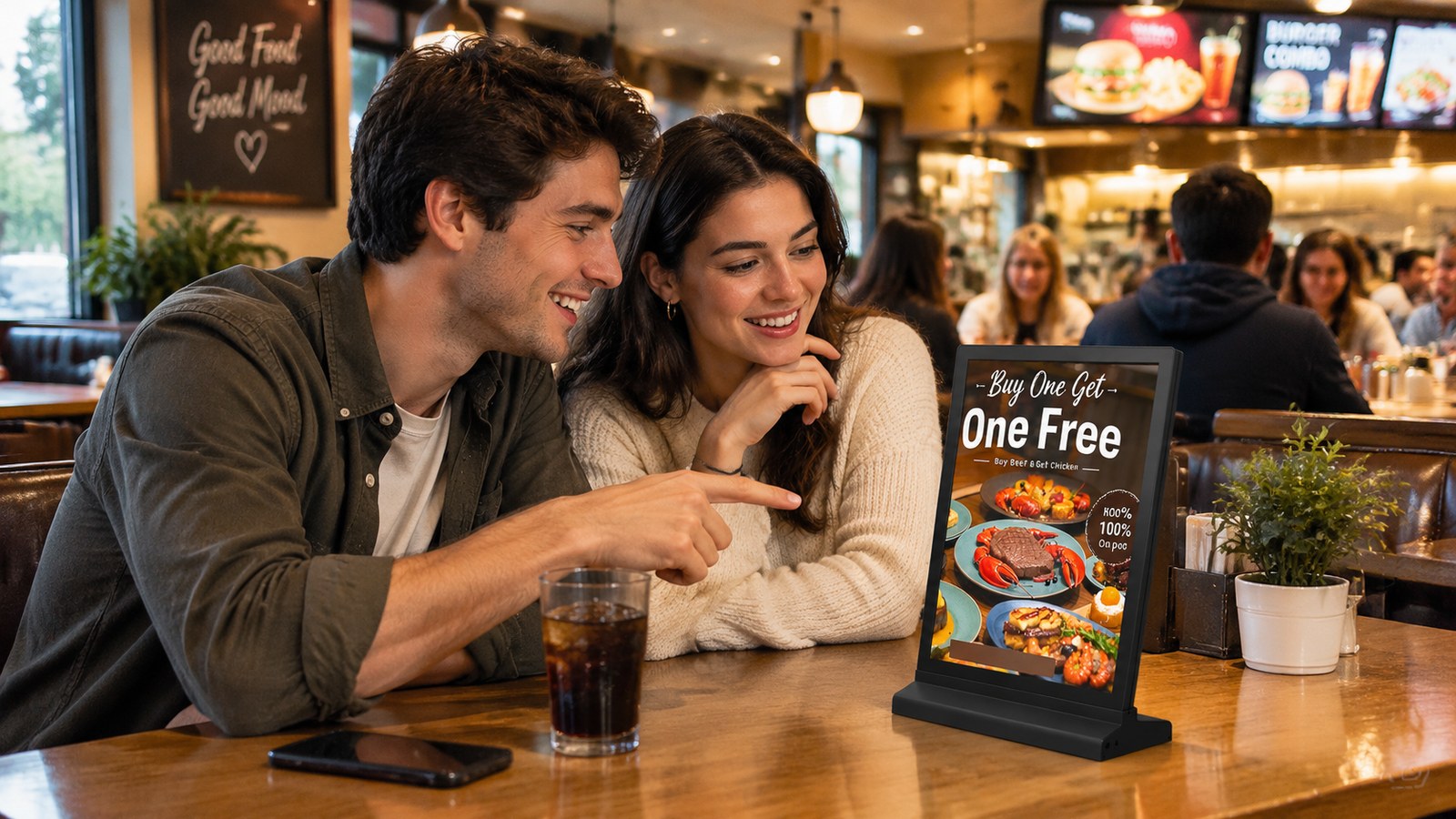
Digital screen tabletop display are not on the main ordering line. Many stores forget them. Customers sit down and wait ten or twenty
minutes. Their eyes are free. That is your chance to sell dessert, a second drink, or a membership.The digital tabletop display can make
them order one more dish after they see good food. Full-service places, fast-casual places,
and coffee shops where people sit all work. A takeout-only store? Customers never sit. Table tents do little there.
Floor-Standing Signage Manages Patience in Line
If placed on the first floor of a shopping mall, standing advertising displaycan help attract customers to the restaurant, boosting both its visibility and foot traffic. If positioned at the restaurant’s entrance, floor standing LCD advertising player can display the current queue status, estimated wait times, and a preview of the menu—giving customers something to engage with while they wait.
Industry data indicates that digital signage can reduce a customer’s perceived wait time by approximately 35%. While the actual duration of the wait remains unchanged, this helps lower customer frustration.
|
|


Wall Mount Digital Signage : The Main Decision Spot
Wall Mount Digital Signage usually hang behind or above the counter. It is important to avoid treating everything as a priority; an excess ofcontent can easily overwhelm customers with too much information. High-margin products and combo deals should be placed in the upper-middle or upper-left sections of the wall-mounted digital signage, as these are the areas where customers’eyes naturally land first. The main menu should occupy the majority of the screen space, while leaving room to highlight limited-time offers and add-on options. Furthermore, cloud-based control for wall-mounted digital signageis a key feature that enhances the efficiency of updating content.

Hanging Bar LCD Display Fill the Gap
They are typically mounted on walls rather than placed at a front desk, serving a different purpose than wall-mount digital signage. Some stores have high ceilings. Some have ordering stations spread out. Customers in line cannot see the wall screen. Hanging bar LCDdisplay fix that. Hang them 7 to 12 feet up. In bright places, make them bright and anti-glare. Usethewall mounted bar LCD displayfor category names, combo anchors, and prices. Do not put long descriptions there. The display fill a gap.
Self-Order Kiosks Change How People Order
Self-order kiosksare not traditional menu screens. But they change the ordering step the most. A self-ordering kiosks never
forgets to suggest a side, a drink upgrade, or an extra. It asks every time. According to feedback from merchants, the implementation of
self-service ordering terminals has led to shorter wait times for customers, higher average transaction values, fewer ordering errors,
and reduced labor costs—all of which enhance operational efficiency in restaurants.
Where you put them matters. Too close to the counter and it gets messy. Start with two or threedigital ordering kiosks. Check usage and
wait times. Then decide if you need more. High-volume fast-food and fast-casual places fit best. A low-volume full-service store
has a weaker reason to buy them.
Build Around Customer Flow, Not a Quote Sheet
You do not pick one screen from five. You look at where customers go and find the gaps. A fast-food store can make the wall
screen the core. Put floor standing display or poster earlier in the line. Add kiosks as a second lane. A fast-casual place can use
digital tabletop display to catch attractafter the meal, next to the counter screen. A coffee shop may need only one wall mount digital signageand digital tabletop display.A store that uses screens well puts one screen where the customer stops and thinks.
VETO offers a range of digital signage displays for restaurants, including wall-mounted menu boards, floor-standing displays,
and tabletop screens. We provide OEM and ODM services, with custom sizes, structures, and configurations to fit different restaurant
layouts and business needs.Welcome to learn more.
location | Format | Main job | Best fit |
Entry / Before the Queue | floor standing display | manage wait expectations, attract attention | QSR, fast casual, high-traffic venues |
Queue sight line gap | hanging bar lcd display | restore menu visibility | high ceilings, food courts, split stations |
Point of decision | wall-mounted menu board | present core menu and price structure | QSR, fast casual, cafe |
seated | digital tabletop display | drive extras, dessert, loyalty | full service, fast casual, cafe with dwell time |
ordering channel | self-ordering kiosk | throughput, ticket lift, labor reallocation | high-volume QSR, fast casual |
FAQ
Q1. What type of digital signage is best for a restaurant?
A: Wall Mount Digital Signageshow menus and prices. Floor-standing displays
catch customers' attention at the entrance. Tabletop displays help promote desserts, drinks, and other extras. Choose based on where you want to place the screen and what you want it to do.
Q2. How many digital signagefor restaurant that I need?
A:It depends on your menu and counter space. A fast-food restaurant with a large menu may need several
screens. A small cafe may only need one or two.
Q3. How do I upload content to a digital signage display?
A:Most displays support USB or Wi-Fi for content updates. The available options depend on the model.
Q4. Can digital signage help increase sales?
A :Yes. You can use the screens to promote combo meals, special offers, desserts, and drinks. Self-ordering kiosks
can also suggest extras when customers place their orders.
Q5. Should I choose a touchscreen or a non-touchscreen display?
A:Choose a non-touchscreen display to show menus, prices, and promotions. Choose a touchscreen if you want customers
to browse the menu and place orders themselves.
Q6. Can I customize digital signage for my restaurant?
A:Yes. You can customize the screen size, mounting style, appearance, and hardware to fit your needs. VETO offers OEM and ODM
services for custom digital signage displays.


Send your inquiry
Name*
Email*
Whatapp
Your Requirements*
Never miss a moment
E-mail*
*


